
Disclosure: This post contains affiliate links. If you click through and make a purchase, I may earn a small commission at no extra cost to you.

When we think about a household task, I feel most people see it like this:
Chore needs doing → chore gets done
In my experience though, the process of a household task is performed is more like this:
Notice → plan → supplies → time → perform → remember next time
Admittedly, these steps don’t need to take a long time, and not many people are standing in front of the dishwasher with a 6-point strategy just to unload it.
But this is a process that takes place for every chore in your home. Whether you do it automatically, or need a minute to think before tackling a task.
And that is my point.
You are making these decisions multiple times a day, all while answering emails, feeding children, running errands, arranging social events, and trying to pay bills.
If you are the person who shoulders that responsibility in your home, no wonder you are mentally fatigued. No wonder that the pile of laundry feels like so much more than just some fabric that needs washing.
A SAHM and Homemaker are NOT the same thing
As a SAHM (stay-at-home-Mum) and homemaker, with a husband that works full-time outside of the home, and two young kids, I end up performing most of our household and home maintenance tasks.
For me, being a SAHM and being responsible for managing my household are two overlapping, but distinct roles.
And both roles go beyond the physical aspect of performing them.
For example, my husband might be the person going out to do the grocery shop, but I’m the one who checks our current food supplies, sees what plans we have for the week to adjust how much food we need in the home, and does the meal planning.

The person performing a chore or a task isn’t always the person who is carrying the responsibility for it.
And that is what this audit is designed to help you see.
The Household Chores Audit
The idea of a household chores audit isn’t a new one. The team at Real Simple (you can check it out here: https://www.realsimple.com/home-organizing/dividing-household-chores ) created a brilliant one, but didn’t quite capture the steps that take place prior to a chore being completed.
So, I’ve attempted to create my own.
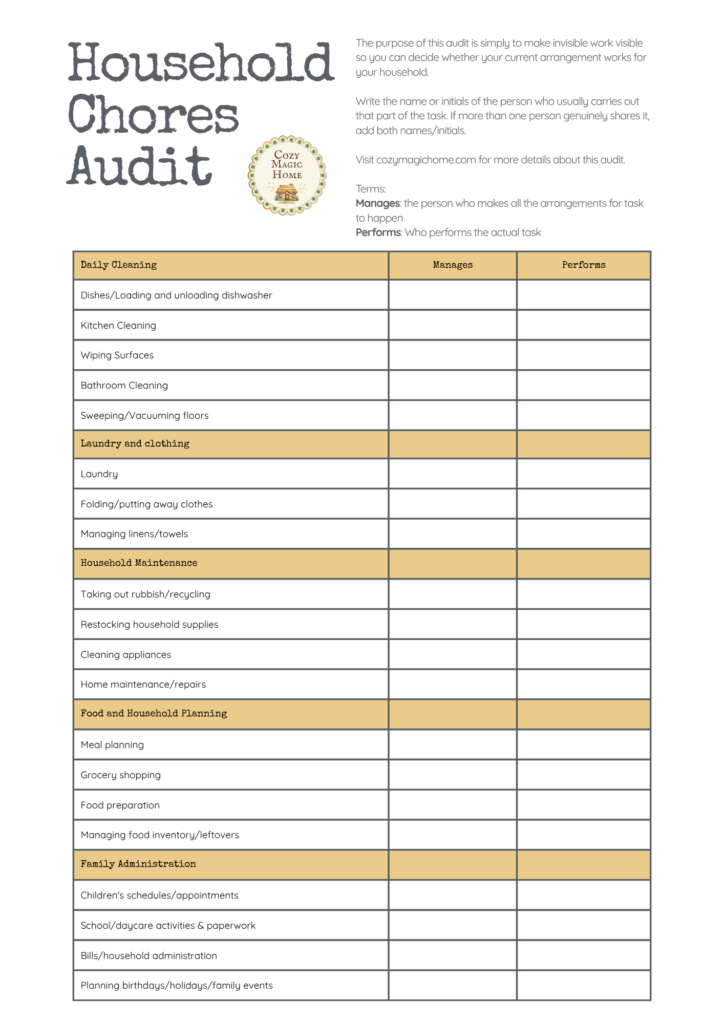
This audit asks you to notice the who does the following:
Manages: This includes everything that needs to be done before the chore can be performed. The noticing, the scheduling, ensuring the supplies needed are available etc
Performs: This is the person who performs the actual chore.
In my household our biggest friction occurs with the mental planning and performance of chores, so those are the areas I chose to focus this audit on.
For example, with the ‘noticing’ part, my husband and I both notice something needs to be done (e.g. dishes need doing before bed). My husband doesn’t mind occasionally thinking ‘I’ll leave that for tomorrow’, whereas I’ll stay up late to make sure the sink is empty for the morning.
A more useful question for us is ‘who carries the responsibility of making the task happen, and who actually performs it?’, as noticing a task doesn’t always lead to the task being performed.
How to complete the audit
Write in the name or initials of the person who typically performs the action described in each category. It can be more than one person if needed.
My husband and I completed this by sitting down together and going through it.
Having said that, it might be better to complete the audit individually, and then compare answers.
It’ll save any potential bickering.
Trust me on this.
You can download a copy of the audit below:
What to do once you’ve completed the audit
Once your audit is completed, start looking for patterns.
Questions to consider:
Is one person doing more of the planning?
Who does a majority of the performing?
Are some categories more evenly divided than others?
Are the same people appearing in both columns?
Use these patterns to have an honest conversation about the division of labor in your home, what you are happy with, and any changes you’d like to make.
You can use this conversation and audit as a springboard to create a personalized homemaking routine.
Fair doesn’t mean equal
The likelihood is, every chore will not be 50/50.
Each household is unique, has different abilities, schedules, preferences, and responsibilities.
For example, I take on more of the duties at home because I am physically present at home more than my husband, so I sometimes have more opportunities to complete chores. I also don’t mind them terribly, whereas my husband doesn’t enjoy cleaning.
But he understands that it isn’t something I want to do all the time.
The goal of the audit is to help you examine whether the current arrangement for managing and completing household work works for everyone in your household.
How to make changes
After completing this audit if you find there are changes that need to be made, I would advise working through one issue at a time.
I say this because in my experience, focusing on one issue at a time is more likely to lead to lasting change.
Also consider the following when deciding to make changes:
- What would I like to stop being responsible for?
- What task can else take ownership from for the complete process?
- What information/access is needed to take ownership for the complete process?
And my last tip, if you decide that some tasks need to be redistributed,focus on the management of the whole task, instead of reassigning the individual task itself (which may lead to only certain aspects being covered again).
An example of this, asking someone to do the laundry vs asking someone to manage the laundry are two different things.

Doing the laundry might be interpreted as washing one load.
Managing the laundry includes the ‘prep’ work (e.g. pre-treating clothes, ensuring you have detergent) as well as the drying and putting away of clothing.
Instead of redistributing an action, redistribute the management of responsibility.
A Note About the Audit
This audit has been designed as a practical exercise to help highlight the invisible labor that make up household chores.
It is not a clinical assessment or measure of whether your household is fair.
Further Reading
Fair Play by Eve Rodsky explores the division of invisible labor and domestic labor between partners and offers a broader system for discussing responsibility and ownership within a household.
I haven’t read it yet, so while I can’t personally recommend it, I came across Rodsky’s work while researching this blog post, and wanted to include it for anyone who wanted to research this subject further.
Before you go
Keeping home isn’t a collection of tasks.
You are constantly in a state of noticing, planning, remembering and doing.
Seeing it written out can help you in acknowledging all that you do, and if it’s working for you.
Until the next magical mess,
Amrita
Leave a Reply