
Last week, I created a visual cleaning checklist in order for my daughter to help her complete her chores.
The inspiration behind creating the visual cleaning checklist came from the realization that we had a very different understanding of what it meant to clean.
So as an experiment this week, I asked her to explain her understanding of words I commonly use (not always directly with her though) to talk about cleaning our house.
It was eye opening.
Definitions
Notes:
‘Actual definitions’ sourced from https://www.merriam-webster.com/, except where noted below:
*https://dictionary.cambridge.org/us/dictionary/english/deep-clean
**https://www.ebsco.com/research-starters/social-sciences-and-humanities/stay-home-parenting-trends
| Word | My kid’s understanding | Actual definition |
| Clean | the floor is clean and that’s it | to rid of dirt, impurities, or extraneous matter |
| Deep clean | it means you clean the whole house, and then scrub it with the soap scrubber | a very complete cleaning process that includes all parts of something, not just surfaces or places where dirt can be seen* |
| Tidy | all the shelves are neat | to put in order |
| Organizing | putting similar things on shelves that have stuff on them | to arrange elements into a whole of interdependent parts |
| Order (arrange) | putting stuff in an array (she actually said array) | to put in order |
| Re-set(ting) | if something isn’t clean, you clean it again | to put back into an original place or position |
| Housekeeping | that means you keep the house clean | the management of a house and home affairs |
| Chores | all boring cleaning stuff you make me do | the regular or daily light work of a household or farm |
| Stay-at-Home Mum/Dad | a person who takes care of the kids and also cleans and cooks | Stay-at-home parenting refers to a family arrangement where one parent stays home to care for children, while the other typically works outside the home. ** |
| Homemaker | same thing as stay at home parent | one who manages a household especially as a spouse and parent |
| Sanitize | putting hand sanitizer on everything | to reduce or eliminate pathogenic agents (such as bacteria) on the surfaces of (something) |
| Maintenance | when your car is not working, you fix your car | to keep in an existing state (as of repair, efficiency, or validity) : preserve from failure or decline |
| Disinfect | when you get the germs out of everything | to cleanse (a surface, a device, a supply of water, etc.) by destroying, inactivating, or significantly reducing the concentration of pathogenic agents (such as bacteria, viruses, and fungi) : to treat (something) with a disinfectant (such as chlorine, hydrogen peroxide, or sodium hypochlorite) |
Lessons Learned
- I didn’t know the official definitions either
I think I instinctively knew what they meant, but I’m not sure I knew the official meanings of some of the terms I was using when talking about housekeeping.
It led to the following point…
- I’ve been using the terminology interchangeably.
As I wasn’t quite clear on the official definition of the words, I have been using them interchangeably.
I usually tell the kids it’s ‘time to clean up’, and most of the kids’ songs I know about use the term ‘clean’ too.
But if we go by the official definitions, what I’ve wanted them to do is tidy up, or re-set.
- I have not been using age appropriate terminology.
I’m fortunate that she is an academically gifted kid, but is it fair for me to expect her to understand some of these terms?
How We Are Moving Forward
- Defining what we mean when we use certain homemaking terms
We sat down as a family, had a quick chat, and agreed up upon what certain homemaking terms mean for our home (look under heading ‘Takeaway (+ free printable) for more details).
- Ensure everyone understands
Though I had never planned on, my daughter assured me I don’t need to ‘dumb anything down’. We’ve agreed that I will double check if she understands what I mean when I say certain things.
- Encouraging Questions
I also assured her that it’s okay for her not to understand everything or even remember.
Though billions of questions a day can be exhausting, I’ve encouraged her to ask me or another adult if she is unsure of terminology we are using, or she doesn’t understand exactly what it is we have asked her to do.
The Importance of Defining What Clean Means in Your Home
While everyone in my home (maybe not the toddler) had an understanding of what the word ‘clean’ means, how we all believed clean ‘looked’ varied wildly.
Sitting down to discuss and mutually agree on what these terms would look like in our home has meant we now have:
- Clearer expectations of what needs to happen if something needs ‘cleaning’, ‘tidying’ etc
- What actions are required to achieve desired outcome (e.g. daily cleaning means removing visible dirt, a tidy up means putting things away etc).
- How often we need to perform said action
As we now have agreed upon definitions, we have at least a shared baseline of our home should look.
It also means when someone is assigned a task (whether it’s me, the kids, or my husband), the language we use gives us an idea of what needs to be done, which has led to a lot less confusion.
Takeaway (+ Free Printable)
I realize every home is different, but me and my kiddo seem to work better with things written down. So after going through these definitions, we worked together and created the following to stick up on our community notice board¹
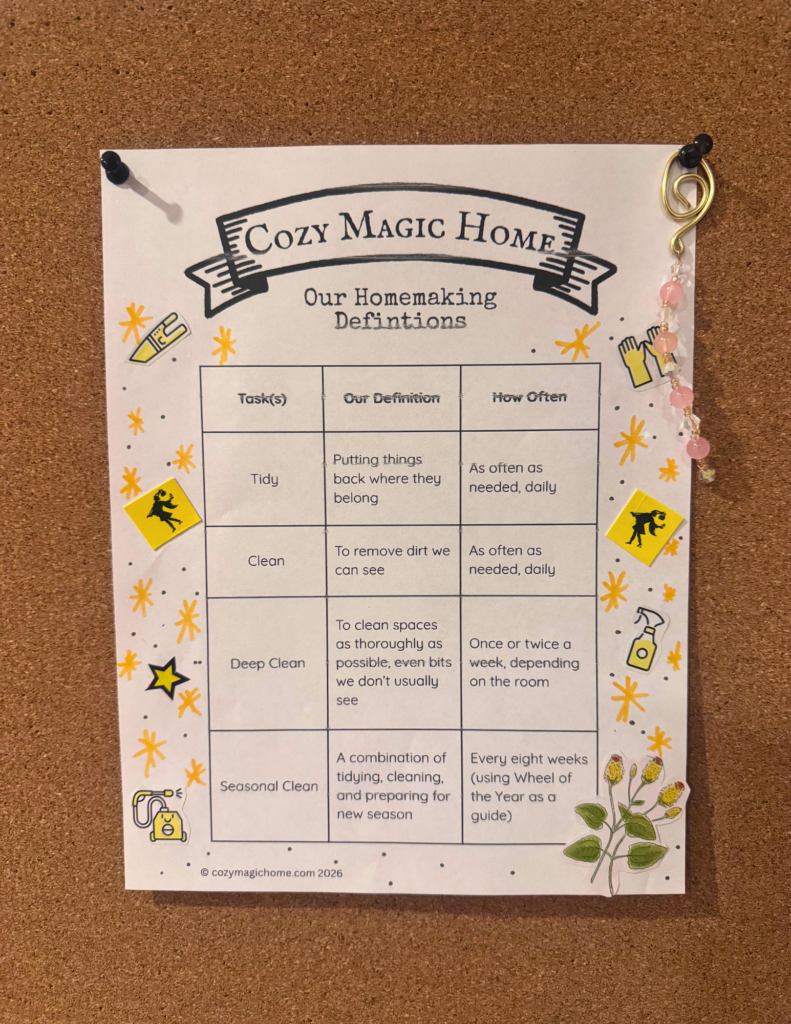
If you would like to make your own version of this, you can grab a copy from the link below:
(¹ – Sometimes we pretend we live in a magical inn, and the cork board we stick art work on become our ‘community notice board’).
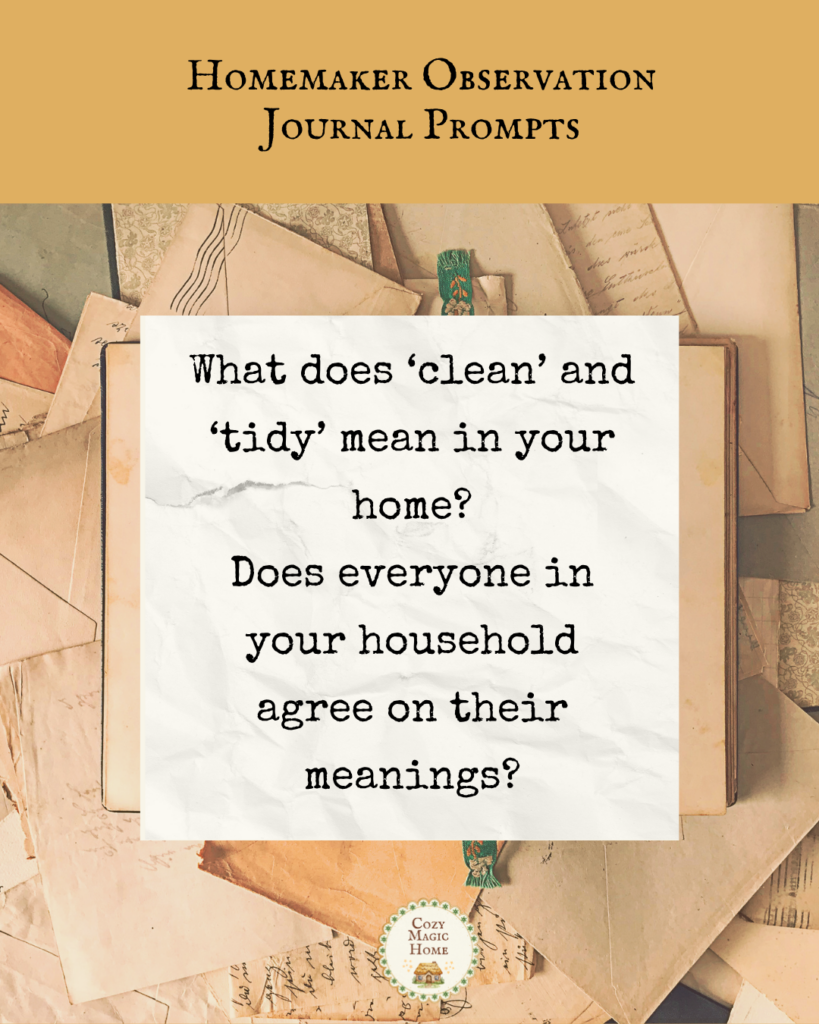
Homemaking Observational Journal Question
If you enjoy journaling, consider reflecting upon the following:
Don’t be a stranger
Have any questions about today’s post, or homemaking in general?
Drop your question below, or email me at hello@cozymagichome.com
I genuinely would love to help, and reply personally to all messages I get.
I hope you day is cozy and magical!
Until the next magical mess
Amrita
Leave a Reply