

Homemaking has not come naturally to me.
Sure, I’ve always known how to cook a few meals, and how to keep things clean.
But the art and science of managing a home is one I have learned through trial and lots of errors. I often think that if my homemaking persona was a Tarot card, I’d be the Queen of Pentacles. If I’m completely honest though, I will forever remain The Fool.
And that is not meant in a self-deprecating or insulting way at all. Even after 11 years of being a homemaker in a bunch of different settings, I will never know it all, and I will always go into a homemaking challenge with blind optimism (maybe after a bit of complaining).
But something I am confident in is my ability to learn from the past, and adapt. From being a newly married homemaker in a one bedroom apartment, to growing our family to include 2 kids, a cat and living in a three bed house with a yard, I’ve always been able to figure out the rhythm our home beats to, and work with it to make our home feel cozy and magical.
The key to that for me has been following a rhythm instead of a routine. Why I love the familiarity and stability a routine brings, a rhythm allows for flexibility, which with a young family is so much better suited to our needs.
Want to do the same with your home too? Here is how you can create a homemaking rhythm that fits your life:
At A Glance
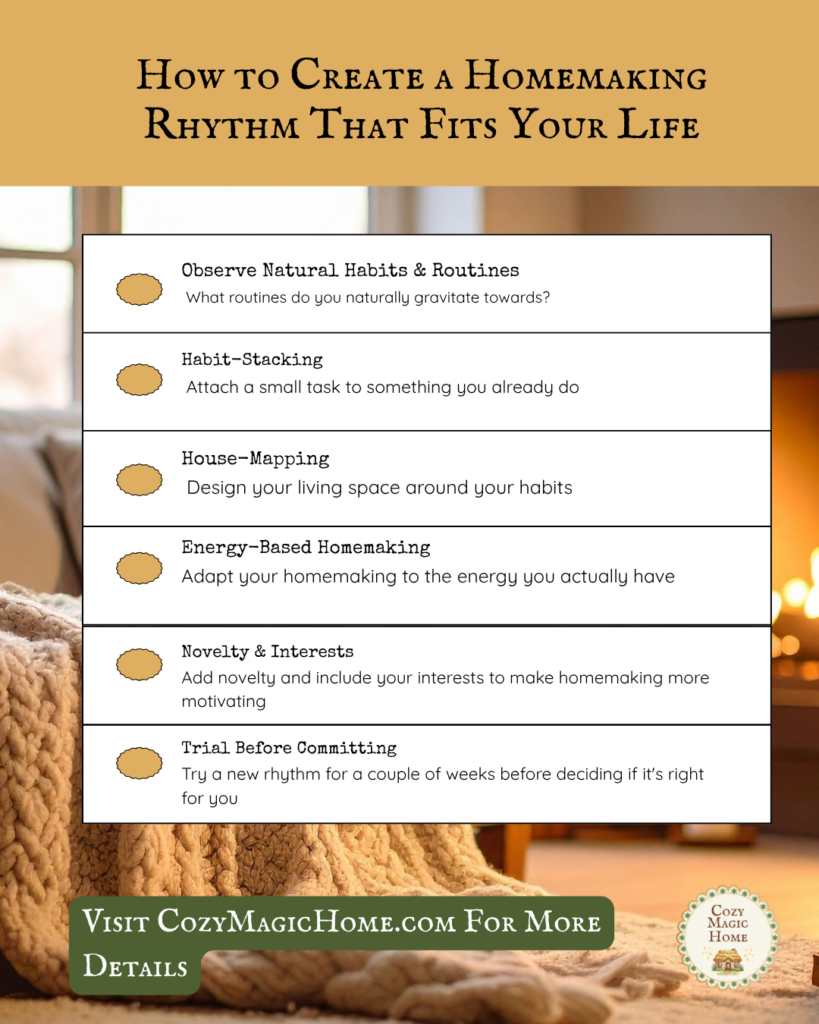
Creating Your Own Homemaking Rhythm
- Observe natural habits and actions
- Habit stacking
- House-mapping
- Energy based homemaking
- Add novelty and interests for motivation
- Trial before committing
Start Observing your Natural Habits and Actions as a Family
I think the best thing I have done as a homemaker is to treat it as a huge experiment, instead of a series of chores that need to be completed.
It has led to me becoming much more observational to our daily life, and helped me to add more intention to our everyday life.
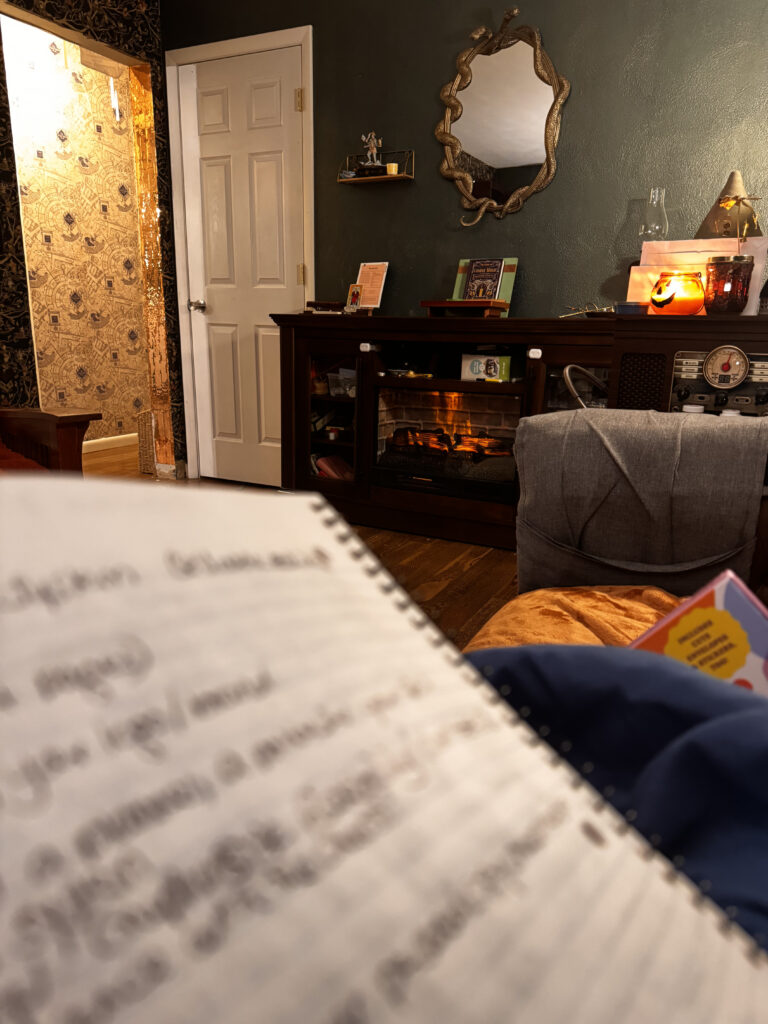
Observing our habits and behavioural patterns as a family has helped me to establish chores we all naturally gravitate towards and/or avoid. It led to honest conversations and figuring out a homemaking system that works for all of us.
Homemaker Observation Journal Prompt: How do you want your home to feel? Do your current actions support that goal?
Knowing what we do/don’t do has also made the next step a lot easier.
Habit Stacking
Habit stacking (a term made popular by James Clear) is the concept where you add a new habit to one you already consistently do.
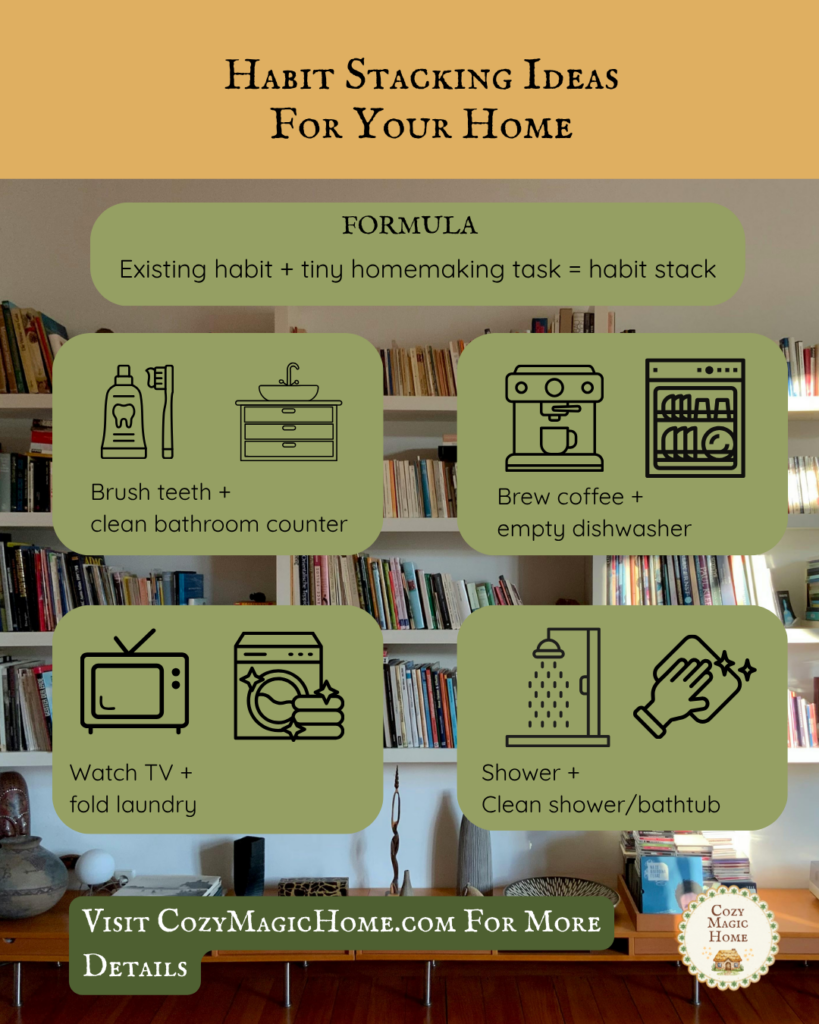
For example, I don’t forget to wash my hands after using the bathroom. But in the general rush of the day, I might put off clearing the bathroom counter.
As a cluttered counter really upsets me, I’ve stacked the two. After washing my hands, I put away anything that might have been left on the counter, and give it a quick wipe. I make sure to do this especially before bed. Brushing my teeth and doing my morning skincare routine in a clean, clutter-free environment always feels good.
Homemaker Observation Journal Prompt: What chores always get done? Which chores feel like they always get missed? How can you stack the two?
House Mapping
Dr Amelia Kelley sums up house-mapping beautifully:
House mapping is one of the simplest ways to make your home actually work with your ADHD brain instead of against it.
If a pile keeps showing up in the same spot, that spot is telling you something. Either make the behavior easier (put storage where the pile lives), or interrupt the pattern before it starts.
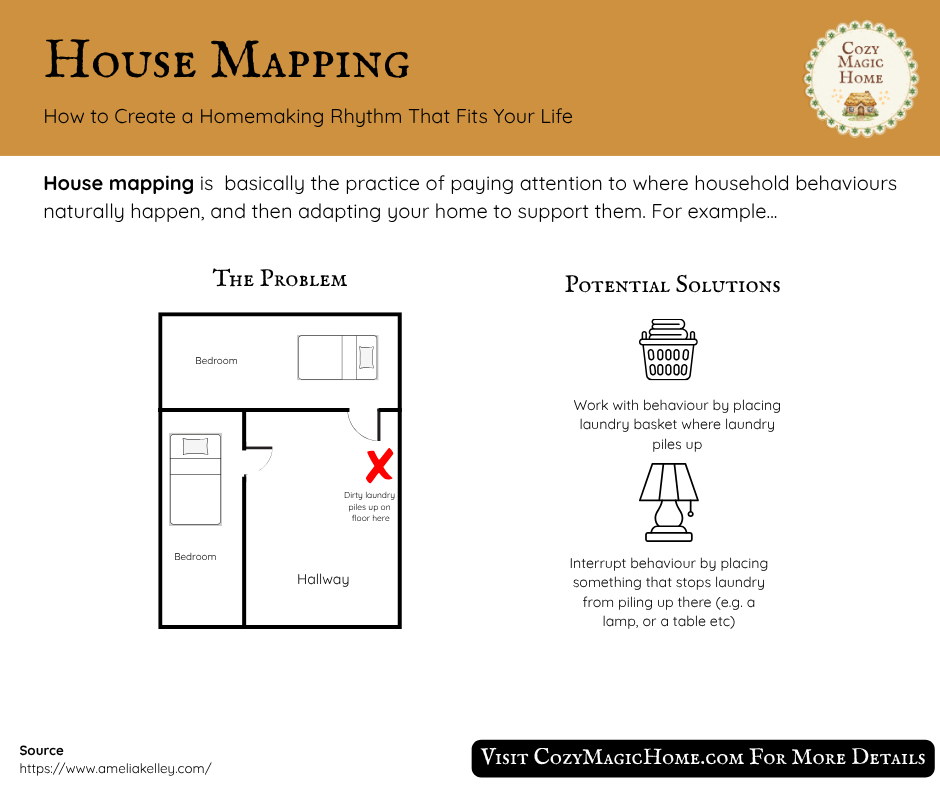
An example for us happens to be laundry. My kids keep throwing their laundry right outside of the bedrooms (to be fair, the 20 month throws everything, but throwing clothes where they shouldn’t be is a cherished hobby for him right now). It’s in a very narrow part of the hallway, so it’s not long before it turns into a laundry mountain (equally fun for the kids).
So now, instead of shouting at everyone to use the laundry basket in the bathroom (individual baskets in bedrooms didn’t work for us), I’ve stuck a laundry basket where they throw their clothes.
It’s still kind of blocking a narrow part of the hallway, but now I just bump into a basket of laundry, instead of tripping on a mountain of dirty clothes.
Not perfect, but it’s currently working for us.
Homemaker Observation Journal Prompt: Are there any corners of your home where clutter naturally accumulates? Why do you think it’s in that spot?
Energy Based Homemaking System
I know I talk about this a lot, but it’s revolutionized the way I keep home.
Prior to creating an energy-based homemaking system*I tried to follow others’ routines. And they really have helped me learn the foundational practices of homemaking.
Generic homemaking routines can be useful starting points, but they don’t account for the energy you actually have, the needs of your family, or the chaos of everyday life.
I currently have three systems (a high energy system, a baseline system, a zero battery system) which I move between depending on my needs.
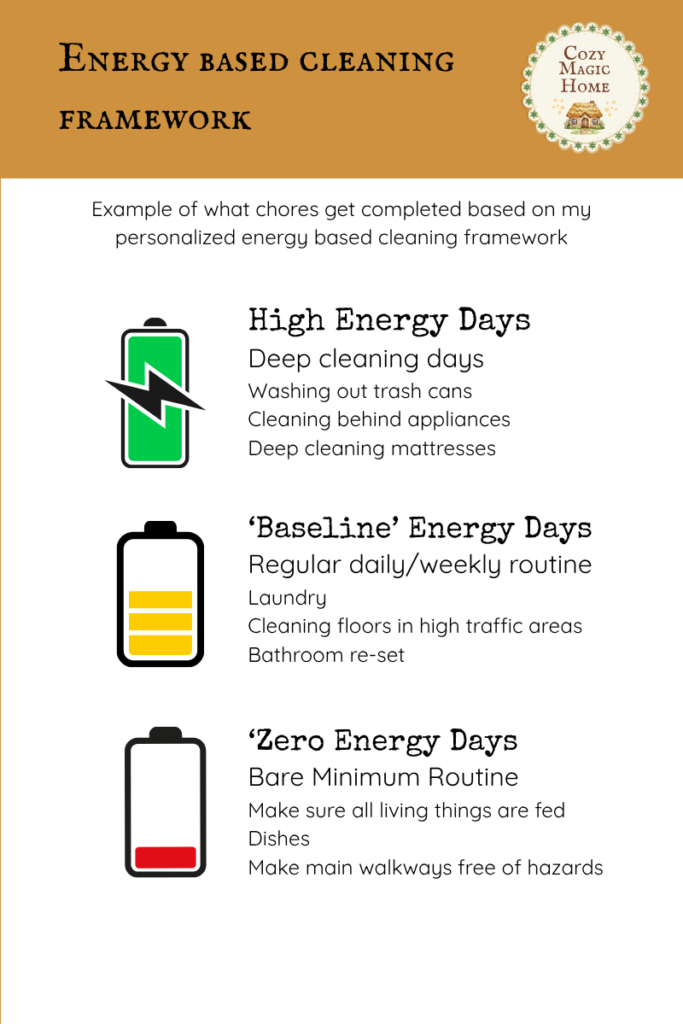
It has been helpful because while I would ideally rest when I have zero-battery, having responsibilities means that isn’t a luxury many of us can afford.
My current system means I have an established baseline of the very bare minimum that will get done to take care of my family and home when I need to rest, as well as having a plan ready for what to do when I am feeling better.
*If you try to create your own energy-based homemaking system, create it when you have baseline energy. That way, you will more likely be realistic about what you can achieve when you have lower/higher energy.
Homemaker Observation Journal Prompt: How can you add more self-care to your current homemaking system?
Add novelty and ‘treats’ for motivation
Admittedly, there are times where homemaking feels tedious.
It certainly feels that way for other members of my family, and they usually are housework avoidant.
Rather than trying to make everyone love housework, we’ve found it easier to make the process itself more engaging.
Something we all are is a little competitive, so we’ve started to add an element of gamifying and competition to our routine.
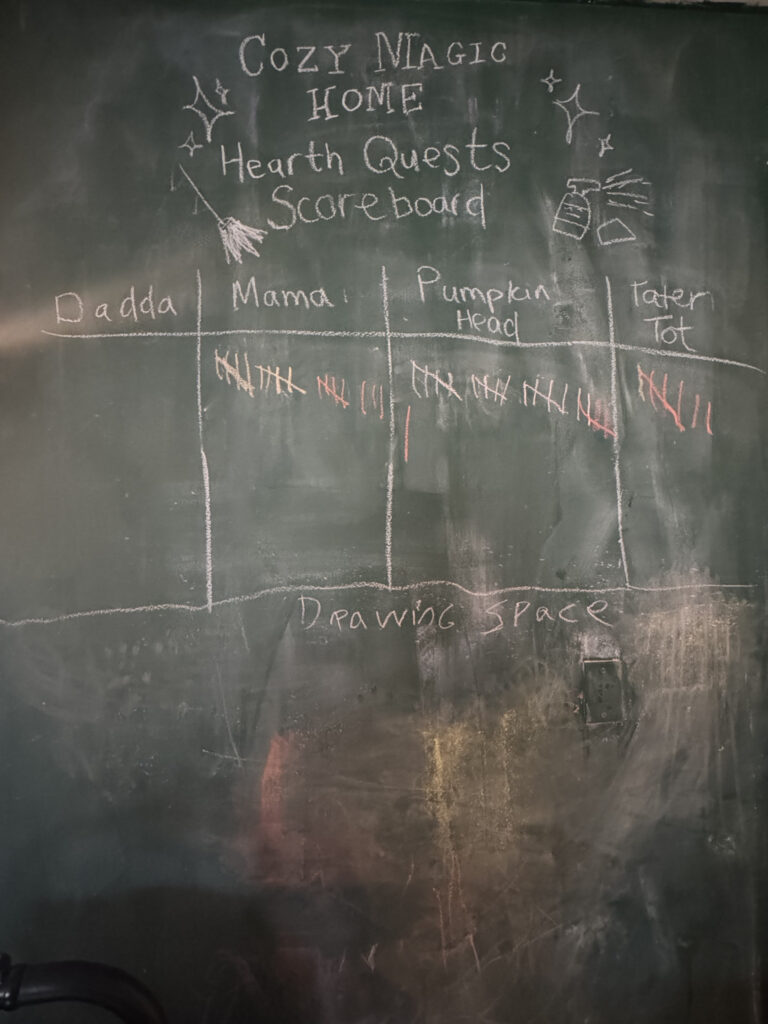
It adds an element of novelty for us, and the winner gets a treat of their choice (my is always a big hot cup of tea, chocolate digestives, and a good book).
We are getting more done, and having fun in the process.
Homemaker Observation Journal Prompt: Does homemaking ever feel fun? How could you add more joy to the process?
Trial a rhythm before committing
While you work on creating or recognizing your own rhythm, it’s okay to try something for a couple of weeks and then decide it isn’t for you.
Just for example, our current hearth quests cleaning system needs a tweak. As a SAHM, I still have more opportunities to clean than my full-time working husband or my full-time student child.
We tweak the game every couple of weeks to make things fairer. It’s not perfect, but we are getting close to a system that works for us.
A key to knowing what is or isn’t working is keeping some sort of record. For me, I have a Homemaker’s Observation Journal where I jot down my findings, but you could use whatever record-keeping method you prefer.
That way, you’ll have some data to refer back to when you do decide if you want to keep or get rid of a rhythm.
Homemaker Observation Journal Prompt: What do you think needs to change about your current homemaking rhythm?
The Best Rhythms Will Keep Changing
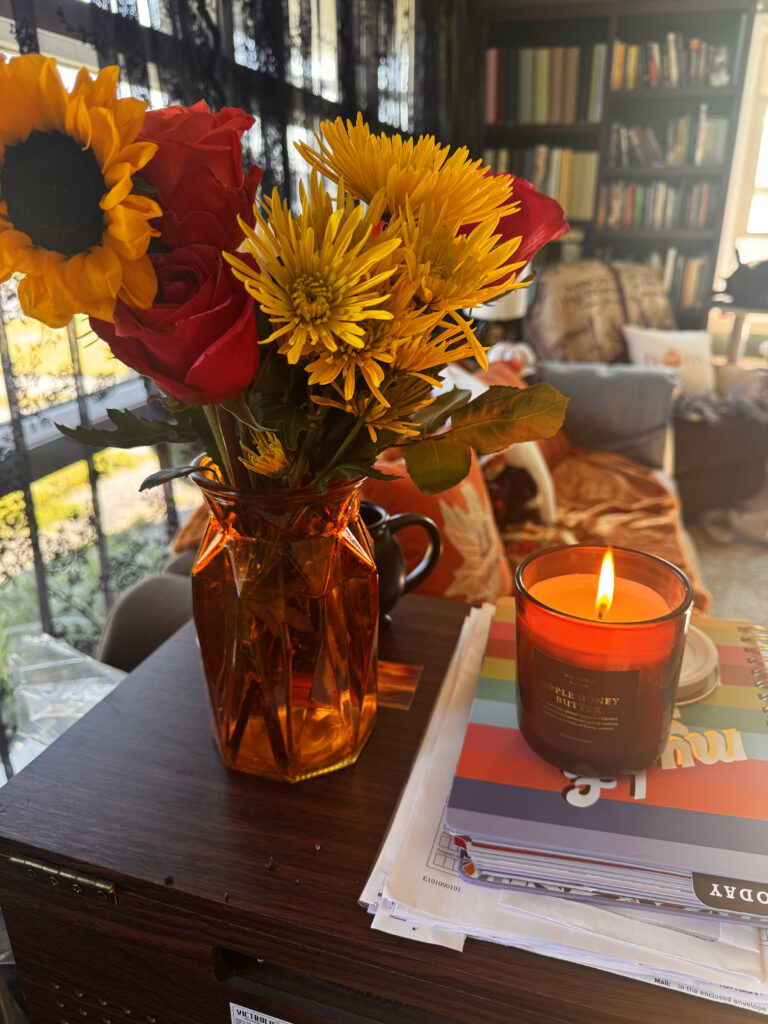
I wasn’t kidding when I called myself The Fool.
I will always consider myself a beginner at homemaking (maybe an advanced beginner on some days).
And so that means I will always be learning and adapting. A good homemaking rhythm should.
You will likely experience something similar. What works for you today may not work six months down the line. Life has a way of sneaking up and lovingly throwing a spanner in the works.
You can’t stop the spanner from being thrown. But you can keep observing, knowing what works for you (and people you live with), and then respond to the thrown spanner armed with knowledge of how your home and habits flow.
That’s the rhythm.
Guide to Help You Build Your Own Homemaking Rhythm
If this way of thinking about homemaking is new to you, you don’t need to overhaul your entire household at once.
I’ve created two resources to help you get started, depending on where you are in the process.
Start small with the free Domestic Rituals Starter Kit.
This is a good place to begin if you’re struggling to establish a few reliable daily anchors. It includes simple rituals for habit stacking, along with a Zero-Battery Map to help you decide what needs to happen on the days when your energy needs to go elsewhere.
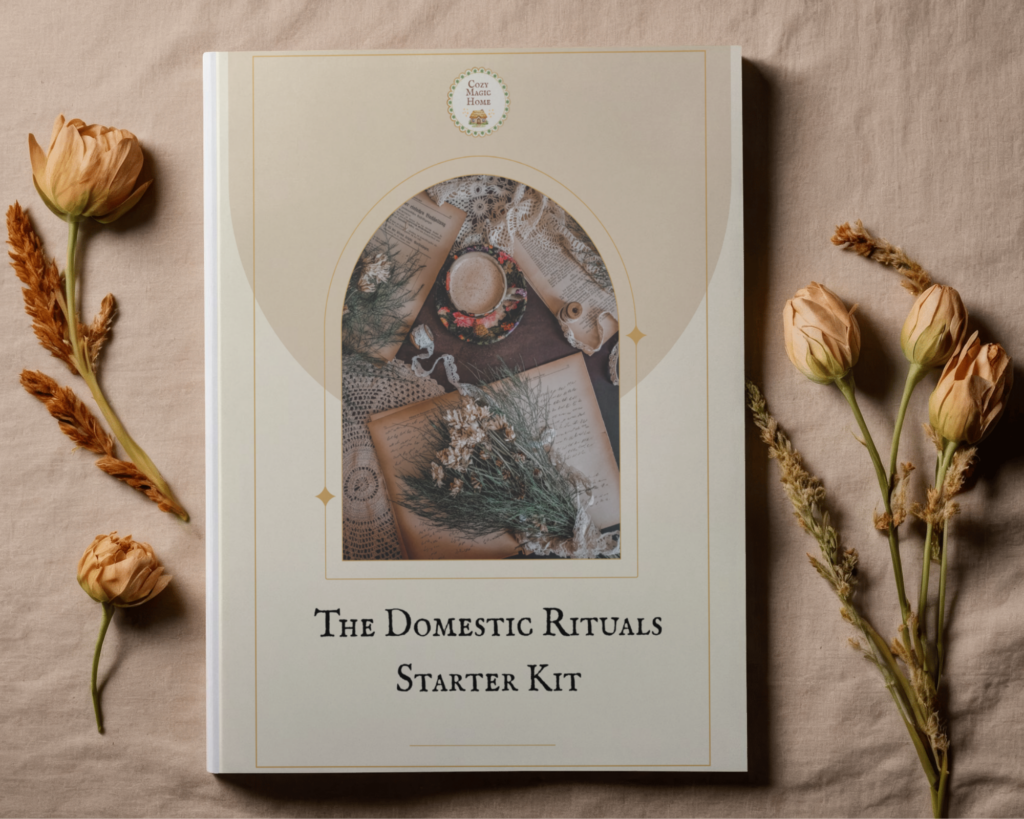
You can get the Domestic Rituals Starter Kit free when you join my monthly newsletter.
Ready to build a more complete system?
The Whimsical Household Rhythm Guide takes the idea further. It’s a gentle, practical guide for creating household rhythms around your actual life, with an energy-based framework that helps you adapt your homemaking to high-energy, baseline and low-energy days.

It’s designed to help you care for your home without turning every day into a battle with your to-do list.
Get the Whimsical Household Rhythm Guide for $7 .
Before You Go
Do you prefer routines over rhythms, or vice versa?
Perhaps you prefer a combination of the two?
Let me know below!
Or if you want, you can email me at hello@cozymagichome.com. I read all my emails and love hearing from you all!
Until the next magical mess,
Amrita